

Wouldn’t it be great if we did not have any problems with our embroidery! Obviously, that would not be very realistic. Sometimes mistakes are made by us or our employees, sometimes the customer changes his or her mind, and sometimes the machine gets nasty and decides to eat a shirt! Unfortunately, these are common issues in every embroidery shop and you need to know how to solve the problem issues when they appear!
It is important to note that sometimes, it is not worth the time that you spend fixing a mistake. One of those times would be when you make an error on a very inexpensive cap! If you can purchase a cap for $2.00 and you have the time to send for a new one, it would not be worth your time to repair the damaged one.
If you have a very expensive garment that belongs to the customer, you need to know how to solve any of the issues that could arise during your embroidery process. It will save you many dollars if something happens to a garment that you cannot replace.
 To watch the videos in full-screen mode, click on the “Enter Full Screen” icon on the right bottom corner of the video.

Video: The Necessary Tools For Making Embroidery Repairs
In this embroidery training video, I show you the necessary tools that I use for all of my repairs. It would be great to be able to embroider everyday and not have any repair or redo issues, but in the real world that just does not happen! You must be prepared for the smallest or largest disaster. Unfortunately, it does happen. Especially, when you are training new people!
Video: How To Remove The Stitches From An Embroidery Design
In this embroidery training video, I show you how to remove the stitches in an embroidery design that was sewn in the wrong color using a “Peggy’s Stitch Eraser”. I have found this tool to be indispensable. Notice that I am turning the shaver upside down to use it. You must be careful that you do not cut holes in your fabric and by leaving your backing in place it can be totally avoided. Sometimes you are faced with this situation and the garment has already had the backing removed and is trimmed. You can still remove the stitching but you must be extremely careful when you are using the Stitch Eraser during this process.
Video: Preparing Garment For Restitching The Embroidery Design
In this embroidery training video, I show you how to steam and prepare the garment for restitching the embroidery design. All of the threads must be thoroughly removed before you can steam the garment. If you have done any damage to the garment while you were erasing the stitches or pulling out the threads then you must repair it prior to steaming. The tiny holes that are left are holes made by the needle penetrating the fabric. There were no holes that were made as a result of using the “Peggy’s Stitch Eraser” or pulling out the threads.
Sometimes a tiny hole has been made. If this is the case, press on a tiny piece of press-on backing right over the hole on the back side of the fabric. If the garment has a lining, as this garment did, you would have to remove some of the stitching in the side seam of the lining to be able to press that piece of backing in place. You would then restitch the lining after you are finished. You do not want to press it to the lining. This would not do you any good.
I also show you how to mark placement for the new embroidery stitching that will be in the exact same spot as the original stitching.
Video: Restitching Embroidery Design In The Same Location
In this embroidery training video, I show you how to restitch the embroidery design in the same exact location on the garment that the previous design was embroidered. You must line up the marked lines with the registration marks in your embroidery hoop as you are hooping your garment. When you put it in the machine you will also line up the needle with the lines in the hoop.
To do this, look at your needle from the side of the machine to line it up horizontally and then look at your needle again from the front of the machine to line it up vertically. You must be in the center of your marked cross hairs on your garment for this to line up perfectly.
It is very important to know how to repair any type of issue in your embroidery designs.
Video: Keeping Dark Garment From Showing Through Design
In the embroidery training video, I show you how to solve a problem when the dark background color of a garment shows through the embroidered design. The embroidery stabilizer or backing that I used in this video was too soft and did not tear away clean and left some fuzzy edges around the border.
You will have a better finished product if you use an embroidery stabilizer or backing that is stiffer and does tear away clean. I no longer use this type of backing for anything. The crisp tearaway backing works better for every project!
Video: Re-hooping Embroidery Garment-It Fell Out Of The Hoop
In this embroidery training video, I show you how to re-hoop a sweatshirt that I accidentally pulled out of the hoop when I was threading the embroidery machine. This could have been a ruined sweatshirt, but with a little practice you can learn to line up your designs perfectly even after they have been taken out of the hoop. It is very important to take the time to learn how to do this. It has saved many garments for me.
Video: Repairing Bobbin Thread Show Through Top Stitching
In this embroidery training video, I show you a quick embroidery tip on how to solve a problem when the bobbin thread shows on top of the embroidery top stitching. Sometimes, when you get to the end of the bobbin, the tension will change and become too loose. This creates a problem with your embroidery if you are not looking at it at the time. I do not babysit my machine. When this happens, I have to have a quick solution. To make sure this is going to be permanent, apply some low heat to it to set it. Be careful that you do not scorch your garment.
Another quick embroidery tip. If you begin to have tension problems with a bobbin that is close to the end, just change it. Don’t try to adjust your tension. Replace it and throw it out. It is not worth your time!
Video: How To Repair Missing Stitches
In this embroidery training video, I show you how to repair missing stitches within an embroidered letter. This same method can be used at the end of a letter or segment where there are some missing stitches. If there is a thread that is loose on top of the garment, pull it through to the backside before you sew in the missing stitches. You may want to apply some Fray Check as well to the area on the backside of the garment. See the video on Fixing Frayed Threads to see how to apply it.
I went over the letter 3 times with the double thread and it filled in completely. I then tied a knot on the back of the garment, pushed the needle up under the letter, pulled the thread through it, and cut it off. The knot stays under the letter and you do not see it.
Video: Design Not Digitized For A Heavy Canvas Bag
In this embroidery training video, I show you how to hoop the inside pocket of a tote bag using the Hoop Tech Embroidery Clamp. I also show you how to solve a problem with a design that was not digitized for this heavy canvas bag.
This same principal will work with many designs that have been digitized and are not heavy enough in density for the fabric that you need to sew it out on. This is especially true if you have a design that was digitized for a woven fabric that you need to use on a knit fabric.
Video: How To Fix Frayed Threads
This is an Embroidery Tip showing you how to fix frayed threads. The thread frayed then broke, so I backed up the machine to restitch that area. Some threads were left on top but I did not want to just trim them off without fixing them first.
This is great to use when you accidentally cut off a lock knot. This is another one of those things that happen when you are training new people. Be prepared for it!
How To Fix A Crooked Logo On Knits!
Do you ever have an issue where your design is slightly crooked on a knit garment? I have a tip that will help with that situation. One time I was faced with 200 sweaters that were all crooked and in the same direction. When I investigated to see what had happened, I discovered that the hooping template was not sitting squarely on the hooping board.
This was long before the HoopMaster. We used a homemade board with holes drilled in every one half inch vertically and horizontally. We made templates that held the hoops in the certain holes for different sized garments.
These 200 sweaters were sent to me by Syracuse University so I could not even replace them. My first thought was to cry. Then, I had to stop crying and come up with a solution.
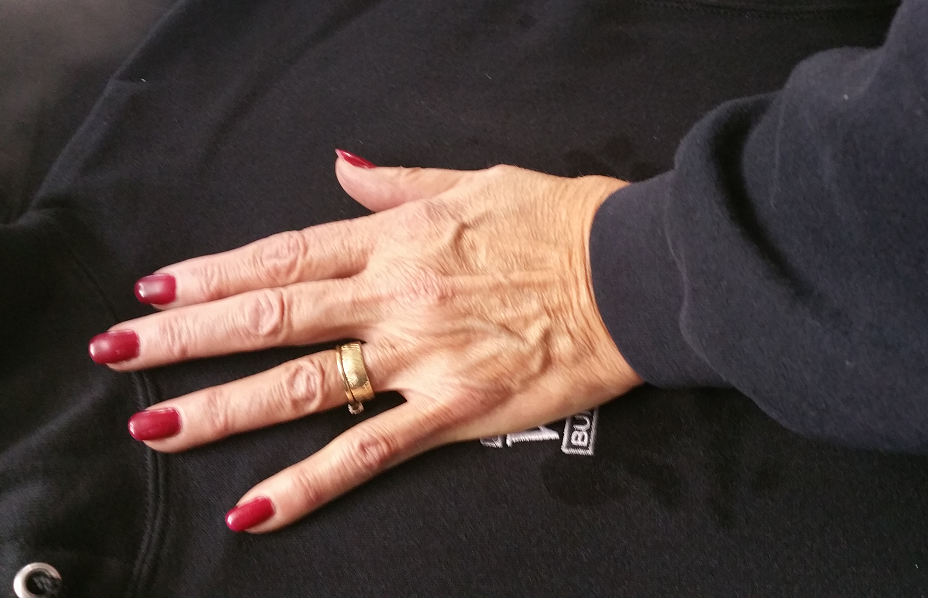
First, I steamed the sweater very heavily and then I took my hand, laid it on top of the embroidery, and twisted it in the opposite direction that it was crooked in. I did this several times, gave it the final steam, and folded it. They all appeared to be straight when they left my shop. I was a nervous wreck worrying about them coming back but not one of them did. The customer was happy with the quality of the work and I was very happy not one was returned. Yes, I got paid! So try it, it works!